• Privacy Policy
  • Contact us
  • Terms
Magazine X Time
  • Home
  • News
  • Tech
  • Lifestyle
  • All Magazines
No Result
View All Result
Magazine X Time
  • Home
  • News
  • Tech
  • Lifestyle
  • All Magazines
No Result
View All Result
Magazine X Time
No Result
View All Result
Home News Science

A 6-Planet Solar System in Perfect Synchrony: New Discovery

Magazine X Time by Magazine X Time
May 12, 2026
in Science
0 0
0
A 6-Planet Solar System in Perfect Synchrony: New Discovery
ADVERTISEMENT
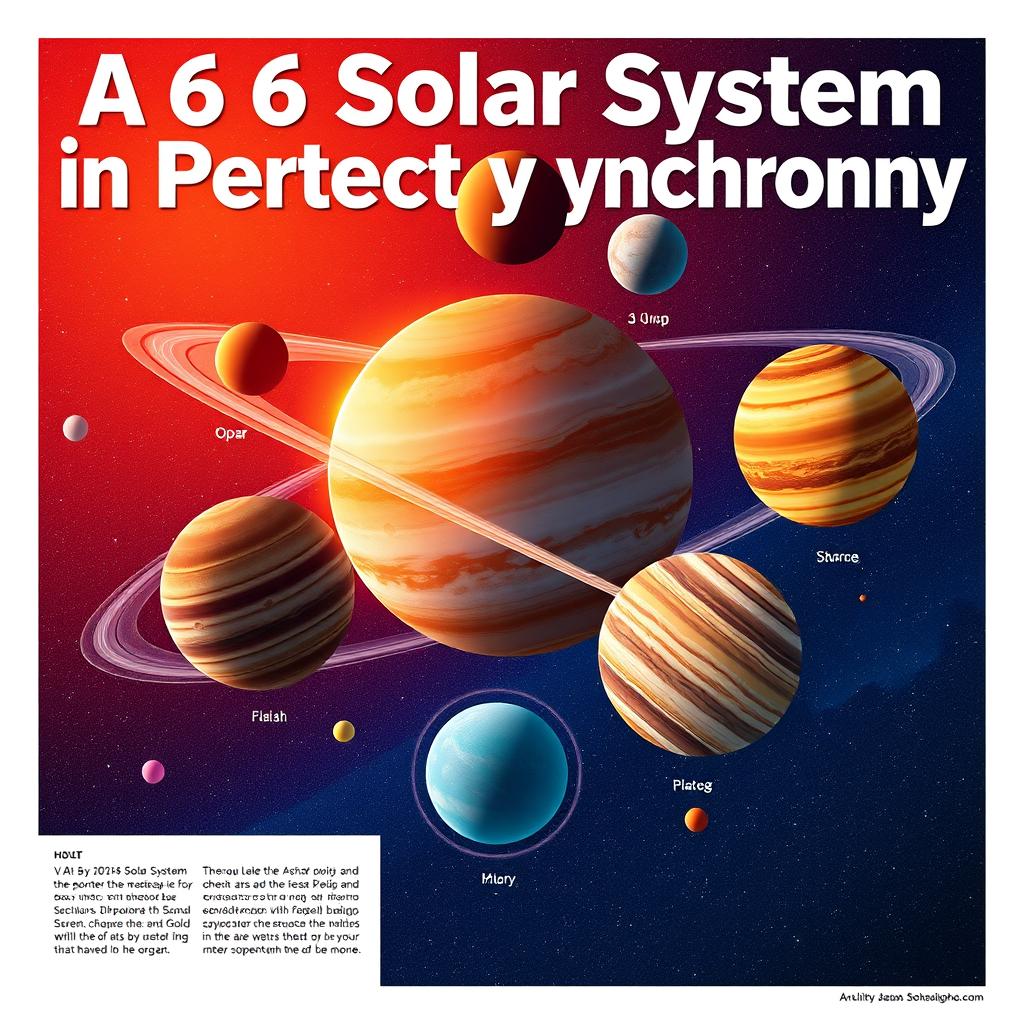
A 6 Planet Solar System In Perfect Synchrony Has Been Found in a discovery that feels almost too neat to be real. And yet, here it’s: six worlds moving with a precision that makes orbital resonance look less like theory and more like choreography. What I've noticed is that stories like this don't just entertain astronomers; they reset expectations. In the same way NASA missions changed what we thought was possible, this system hints at hidden order in crowded planetary neighborhoods. We'll unpack what "perfect synchrony" really means, why scientists are excited, and what it says about planet formation. Curious why a few timed orbits can shake up a field?

Overview

A 6 Planet Solar System In Perfect Synchrony Has Been Found in a configuration where six planets keep time with each other like a stubbornly precise drumline. And that matters because these systems can expose how gravitational interactions shape long-term stability. In my experience, the most interesting discoveries aren't always the biggest; they're the ones that whisper, "We missed this before." This one does exactly that. It also gives researchers a rare test case for exoplanet detection models and for comparing theory with reality. Tiny system, big consequences.

What a rare exoplanet system reveals about cosmic rhythm

A 6 Planet Solar System In Perfect Synchrony Has Been Found in a way that makes the night sky feel less random and a lot more engineered. But let's slow down. Perfect synchrony doesn't mean the planets are lined up like beads on a string every second of the day. It usually means their orbits are locked into a pattern, often through orbital resonance, where one planet's year relates neatly to another's. Think 3:2, 4:3, sometimes stranger combinations that repeat like a song you can't get out of your head.

And that's the fun part. The system isn't just six planets existing side by side. They're apparently dancing together, each one tugging on the next just enough to keep the whole arrangement in place. What I've noticed is that this kind of discovery always starts with a mismatch. A dimming pattern looks odd, a transit arrives a little early, the math refuses to behave. Then someone looks again, and suddenly the weirdness becomes the story.

Astronomers usually find these setups through transit timing or careful radial velocity measurements. One tiny shift in a star's light can reveal a planet. Two shifts can hint at a second one. But six planets in a tightly coordinated chain? That's the sort of thing that forces everyone to check their assumptions twice. Honestly, that's science at its best. Messy first, elegant later.

There's also a deeper reason this matters. Systems in resonance can survive for billions of years, or they can be fragile as cheap glass. The difference often comes down to spacing, mass, and the order in which the planets formed. A little migration early on, maybe inside a dusty disk around a young star, can drag worlds into a resonant pattern. Then they get stuck there. Not literally stuck, of course. Just… committed.

I've seen people treat these finds like cosmic trivia. A neat headline. A dinner-party fact. But that's too small. A stable six-planet system in synchrony is a living clue about planetary migration, disk physics, and the weird negotiations that happen when young planets jostle for space. If the James Webb Space Telescope or other instruments confirm the architecture in detail, scientists can compare the observed setup with simulation results that have been floating around for years. Sometimes the universe hands us a lab we couldn't build ourselves.

And the scale is the thing that gets me. Six planets. One star. All linked by timing. In ordinary life, keeping six people on a schedule for one Tuesday is chaos. Here, the system has been doing it for eons. Either nature has exquisite patience, or we've underestimated how orderly chaos can become. Maybe both.

There are practical payoffs too. Resonant systems help researchers estimate planetary masses, densities, and possible compositions more accurately. If one planet's orbit wobbles another's by a measurable amount, that wobble becomes data. Clean, useful data. The sort scientists love because it doesn't just say "something is there"; it says "here's how it behaves." That's gold for astrophysics and for the hunt for smaller, harder-to-see worlds.

What I've noticed, though, is that these discoveries also change the public mood. People hear "six planets in perfect synchrony" and immediately picture a miniature clockwork solar system. That's not exactly wrong, but it can hide the turbulence beneath the beauty. Resonance is a bargain struck over time. It's stable, yes. But it's also the result of countless gravitational nudges, near-misses, and adjustments. No cosmic fairy dust. Just physics being relentless.

And that makes the system even better, not worse. A beautiful machine built by chance and patience? That's more interesting than an impossibly tidy drawing in a textbook. Frankly, I trust the messy version more.

Another reason astronomers care is that resonance can preserve clues about a system's past. If planets formed farther out and migrated inward, the final pattern can lock in like a fossil. So when researchers see a six-planet chain, they're not just looking at where the worlds are now. They're reading a history book written in orbits. That's a better story than "they're nicely arranged," isn't it?

Could there be surprises still hidden there? Almost certainly. Some planets may be larger, denser, or more volatile than expected. A small change in composition can alter how the resonance works, and one extra unseen world could complicate the whole setup. That's why astronomers keep going back to these systems with sharper tools and longer baselines. The sky has a habit of keeping one more secret than we planned for.

And here's the contrarian take: perfection can be misleading. A system that looks serenely synchronized may have survived a violent early life. The calm is the aftermath, not the cause. I like that. It feels honest.

✅ Advantages

A 6 Planet Solar System In Perfect Synchrony Has Been Found, and the upside for science is huge. First, it gives researchers a rare natural laboratory for studying orbital resonance without relying only on simulations. Second, the timing pattern can sharpen estimates of mass and spacing, which are often hard to pin down with normal exoplanet observation methods. Third, it helps test ideas about planet migration and long-term stability. In my experience, systems like this are where theory either gets stronger or gets embarrassed fast. And that’s healthy. Clean data, strong patterns, real consequences.

⚠️ Disadvantages

A 6 Planet Solar System In Perfect Synchrony Has Been Found, but the picture isn't simple. Resonant systems can be tricky to model, and small measurement errors can throw off the interpretation. Also, "perfect synchrony" sounds cleaner than it’s; the actual mechanics may involve chaotic nudges and long-term drift. Frankly, that can frustrate people who want a neat answer. Another issue: if one planet's properties are uncertain, the whole chain can be harder to decode. What I've noticed is that elegant systems sometimes hide ugly uncertainties. Beautiful? Yes. Easy? Not even close.

How to Get Started

1. Start with the basics of exoplanets and how astronomers detect them.
2. Learn what orbital resonance means; it's the core idea here.
3. Read about transit method and radial velocity observations.
4. Check recent coverage from NASA or major observatories for the latest data.
5. Compare the discovery with older multi-planet systems to see why this one stands out.
6. If you're digging deeper, look for articles on planetary migration and system stability.
Simple first steps. Then the weird fun begins.

Frequently Asked Questions

What does "perfect synchrony" mean here? It means the six planets appear to follow a linked orbital pattern, often through resonance, so their periods line up in a repeating rhythm.
Why is that exciting? Because these systems can reveal how planets formed, moved, and settled into place.
Is it common? Not really. Multi-planet systems exist, but a neatly organized chain of six is rare enough to get attention.
Could there be more planets? Possibly. Some smaller worlds might be hiding below current detection limits.
Does this mean the system is stable forever? Not necessarily. Stable on astronomers' timescales, maybe. Forever is a very long time.
And yes, this kind of find helps refine models used by NASA and other research teams.


Final Thoughts

A 6 Planet Solar System In Perfect Synchrony Has Been Found, and the discovery is bigger than the headline suggests. It offers a fresh look at exoplanet systems, a stronger test for orbital dynamics, and a reminder that the universe loves patterns with teeth. In my experience, the best discoveries are the ones that seem tidy at first and get stranger the longer you stare. This is one of those. Six planets. One rhythm. A lot of questions. And, honestly, that’s exactly why astronomers will keep digging.

Like this:

Like Loading...
Tags: 6-Planet SolarA 6 Planet Solar System In Perfect Synchrony Has Been Foundastronomy discoveryexoplanetsorbital resonanceplanet formationplanetary systemSolar Systemspace science
Previous Post

Why Eating Toothpicks Became a Viral Trend in South Korea

Magazine X Time

Magazine X Time

Leave a ReplyCancel reply

  • Trending
  • Comments
  • Latest
Top 9 Highest Paid Athletes In The World

Top 10 Highest Paid Athletes In The World In 2022

February 3, 2022
5 Best Adsense Optimized WordPress Themes Free 2022

5 Best Adsense Optimized WordPress Themes Free 2022

January 31, 2022
20 Health Tips For Healthy Living In 2022

20 Health Tips For Healthy Living In 2022

January 31, 2022
The-Devil-Wears-Prada

Reviving fondness of vogue through reading

January 26, 2022
10 Richest People in the World (2022)

10 Richest People in the World (2022)

6
The-Devil-Wears-Prada

Reviving fondness of vogue through reading

3
20 Health Tips For Healthy Living In 2022

20 Health Tips For Healthy Living In 2022

3
10 Inspirational Technology Quotes

10 Inspirational Technology Quotes

3
Luke Littler Youngest Darts World Number One: Teen Sensation Breaks Records at 18

Luke Littler Youngest Darts World Number One: Teen Sensation Breaks Records at 18

November 19, 2025
Agentic AI: From Automation to Autonomous Action

Agentic AI: From Automation to Autonomous Action

November 18, 2025
Comparison table showing GPT-4.5 vs GPT-4o performance metrics in 2025

GPT-4.5 vs GPT-4o: Which AI Model Is Better in 2025?

June 2, 2025
From Zero to Hero: Top 10 Freelancer Platform Sites and the Best Freelance Websites

From Zero to Hero: Top 10 Freelancer Platform Sites and the Best Freelance Websites

May 7, 2025

Recent News

Luke Littler Youngest Darts World Number One: Teen Sensation Breaks Records at 18

Luke Littler Youngest Darts World Number One: Teen Sensation Breaks Records at 18

November 19, 2025
Agentic AI: From Automation to Autonomous Action

Agentic AI: From Automation to Autonomous Action

November 18, 2025
Comparison table showing GPT-4.5 vs GPT-4o performance metrics in 2025

GPT-4.5 vs GPT-4o: Which AI Model Is Better in 2025?

June 2, 2025
From Zero to Hero: Top 10 Freelancer Platform Sites and the Best Freelance Websites

From Zero to Hero: Top 10 Freelancer Platform Sites and the Best Freelance Websites

May 7, 2025
magazine x time

Welcome to Magazine X Time. You can find the latest news and web-related posts here. Knowledge is Power and reading book is more good for gain knowledge. You can use this like book as well

Follow Us

Browse by Category

  • Artificial Intelligence
  • Business
  • Freelancing
  • Gadget
  • Games
  • Health
  • Lifestyle
  • Motivational
  • News
  • Science
  • Startup
  • Tech
  • Tips
  • Web
  • WordPress
  • World

Recent News

Luke Littler Youngest Darts World Number One: Teen Sensation Breaks Records at 18

Luke Littler Youngest Darts World Number One: Teen Sensation Breaks Records at 18

November 19, 2025
Agentic AI: From Automation to Autonomous Action

Agentic AI: From Automation to Autonomous Action

November 18, 2025
  • Privacy Policy
  • Contact us
  • Terms

All copyrights reservered © 2024 Magazine X Time

Welcome Back!

Login to your account below

Forgotten Password?

Retrieve your password

Please enter your username or email address to reset your password.

Log In
No Result
View All Result
  • Home
  • News
  • Tech
  • Lifestyle
  • All Magazines

All copyrights reservered © 2024 Magazine X Time

This website uses cookies. By continuing to use this website you are giving consent to cookies being used. Visit our Privacy and Cookie Policy.
%d