
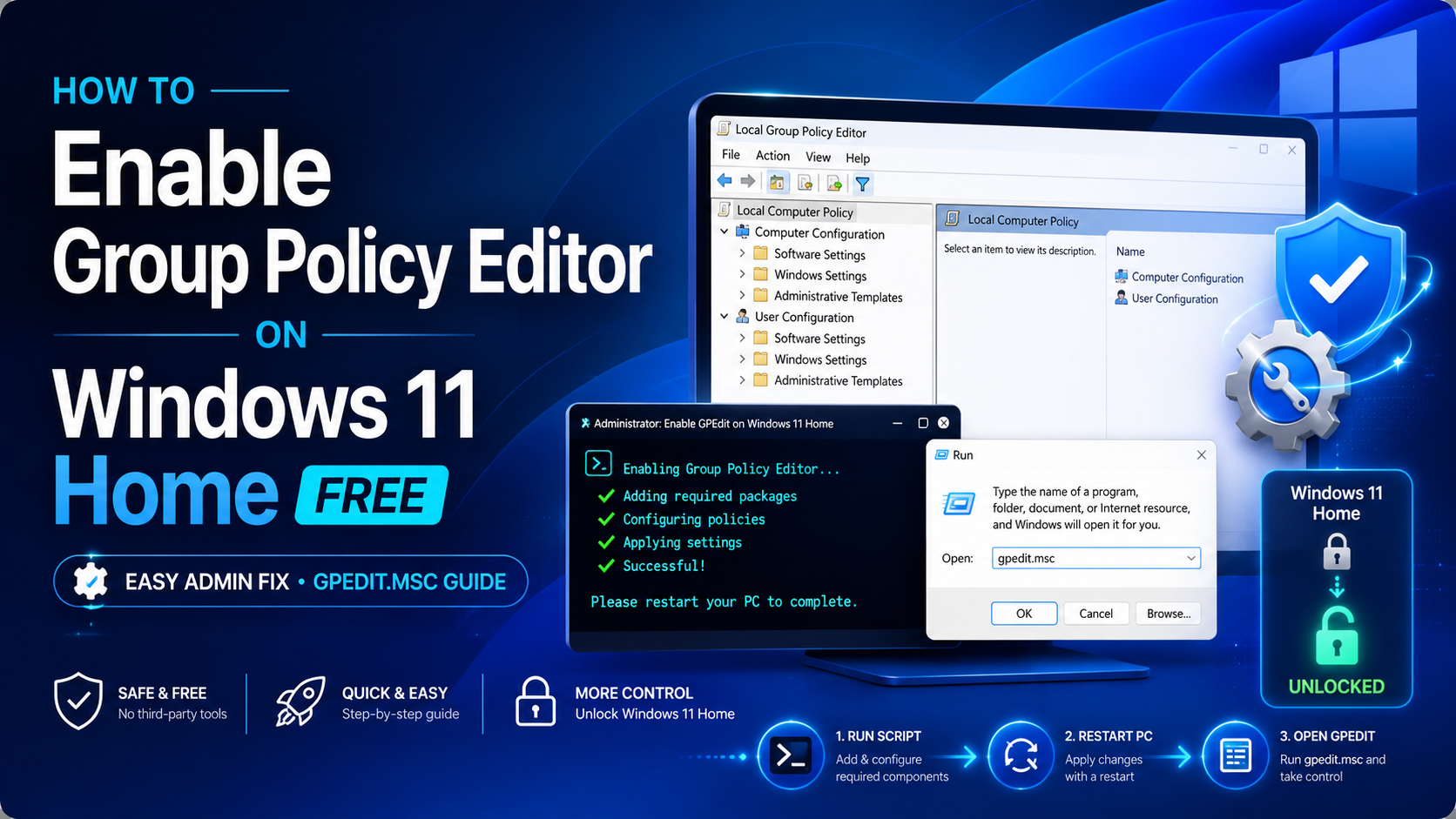
If you're trying to figure out How To Enable Group Policy Editor On Windows 11 Home, you're probably tired of hitting dead ends in windows settings and hunting for a missing tool. Honestly, that frustration is normal. Home edition hides a few power-user features, and the fix isn't magic, it’s usually a small script, a reboot, and a little patience. In my experience, once people see the editor working, they start tweaking local policies, system settings, and admin tools with a lot more confidence. We'll walk through what to do, what to expect, and where things can go sideways. A quick, practical guide.
Before You Start
1. First, check that you're on windows 11 home and not Pro. The steps differ, and mixing them up wastes time.
2. Download or copy the standard enable script from a trusted source. I prefer keeping it simple. No fancy installers.
3. Right-click the file and run it as administrator. If Windows throws a warning, that's expected.
4. Let the script finish completely. Don't close the window early. Seriously, that’s the part people rush.
5, restart your PC, a proper restart, not sleep mode.
6. Press Win + R, type gpedit.msc, and hit Enter. If it opens, you're in.
7. If it doesn't, check command prompt permissions and run the script again. What I've noticed is that one missed admin click causes half the failures.
8. Still stuck? Look at microsoft support pages or a trusted tech forum for your exact build number.
Fixing missing gpedit on home edition
Getting group policy editor running on Windows 11 Home can feel like finding a spare key in a junk drawer. One minute you're ready to lock down updates, disable annoying prompts, or adjust security policies; the next, the editor just isn't there. The usual workaround uses a script to install the missing components, then a restart to make Windows recognize them. In my experience, the process is pretty quick on a clean machine, maybe 5 minutes if nothing goes sideways. But here's the catch: run the script as admin, or it'll fail quietly and waste your afternoon. I once watched a friend try three times from a normal account. Same script, same file, same facepalm, and yes, it was fixed by a single right-click. After that, local group policy opened normally, and the machine behaved like a different animal.
Fixing missing gpedit on home edition
Getting group policy editor running on Windows 11 Home can feel like finding a spare key in a junk drawer. One minute you're ready to lock down updates, disable annoying prompts, or adjust security policies; the next, the editor just isn't there. The usual workaround uses a script to install the missing components, then a restart to make Windows recognize them. In my experience, the process is pretty quick on a clean machine, maybe 5 minutes if nothing goes sideways. But here's the catch: run the script as admin, or it'll fail quietly and waste your afternoon. I once watched a friend try three times from a normal account. Same script, same file, same facepalm, and yes, it was fixed by a single right-click. After that, local group policy opened normally, and the machine behaved like a different animal.
Fixing missing gpedit on home edition
Getting group policy editor running on Windows 11 Home can feel like finding a spare key in a junk drawer. One minute you're ready to lock down updates, disable annoying prompts, or adjust security policies; the next, the editor just isn't there. The usual workaround uses a script to install the missing components, then a restart to make Windows recognize them. In my experience, the process is pretty quick on a clean machine, maybe 5 minutes if nothing goes sideways. But here's the catch: run the script as admin, or it'll fail quietly and waste your afternoon. I once watched a friend try three times from a normal account. Same script, same file, same facepalm, and yes, it was fixed by a single right-click. After that, local group policy opened normally, and the machine behaved like a different animal.
Fixing missing gpedit on home edition
Getting group policy editor running on Windows 11 Home can feel like finding a spare key in a junk drawer. One minute you're ready to lock down updates, disable annoying prompts, or adjust security policies; the next, the editor just isn't there. The usual workaround uses a script to install the missing components, then a restart to make Windows recognize them. In my experience, the process is pretty quick on a clean machine, maybe 5 minutes if nothing goes sideways. But here's the catch: run the script as admin, or it'll fail quietly and waste your afternoon. I once watched a friend try three times from a normal account. Same script, same file, same facepalm, and yes, it was fixed by a single right-click. After that, local group policy opened normally, and the machine behaved like a different animal.
Tips and Gotchas
The big idea is simple: windows 11 home doesn't ship with the full group policy editor visible by default, but many systems can still enable it through a lightweight install routine. That routine adds the needed policy files, registers the snap-in, and leaves you with the same gpedit.msc window people expect on Pro. What I've noticed is that most users don't need a deep system rebuild. They need a clean, admin-level fix and a reboot, that's it. And the first thing to get right is your source. Use a script from a reputable tech guide or a well-known forum thread that matches your build. Microsoft won't officially label Home the same way it labels Pro, so you want a method that fits your version of Windows 11. If you're on 23H2 or 24H2, check the comments and timestamps before you run anything. Old files can break, and broken files are annoying in a very specific Tuesday-morning way. Once you have the script, save it locally. Don't run it from a browser preview, and don't rename it unless the instructions tell you to. Then right-click and choose Run as administrator. A black command window may flash line by line; let it finish. Honestly, this is where people get nervous and stop too early. Bad move. After the script completes, restart. Then use Win + R, type gpedit.msc, and press Enter. If the editor opens, you're done. If it doesn't, check whether windows security blocked one of the files, or whether your account lacks admin rights. On a few machines, I’ve seen Defender quarantine one component while leaving the rest untouched. Messy, but fixable. If the editor still won't appear, don't keep hammering the same file. Remove it, reboot, and try a different trusted package or method. And if your goal is just to change one setting, ask yourself whether you even need the editor at all. Sometimes registry edits are faster, sometimes they're a headache. Depends on the job. The editor is handy, sure, but it's not a trophy. It's a tool.
Final Thoughts
Once you know How To Enable Group Policy Editor On Windows 11 Home, the whole thing feels less mysterious and more like a repeatable fix. Run the script as admin, let it finish, reboot, and check gpedit.msc. Simple. In my experience, most failures come from skipping one of those steps or using a bad file. If it works, great, you've unlocked a handy control panel for local policies and system tweaks. If it doesn't, don't panic. Try a trusted source, verify your build, and start over cleanly. A little patience goes a long way here.